Our lab's first T Level placement in IT Support
We interviewed T Level student in Digital Support, Layla Saunders, about her rewarding work placement with our IT Services.
By Laura Turchi and Mia Cerfonteyn
The Sainsbury Laboratory (TSL), like many research institutes, relies on an increasingly complex digital infrastructure to support our groundbreaking research as well as the training of future scientists.
This dynamic environment and its associated users are expertly managed by our IT Services Manager who works closely with Norwich Bioscience Institutes’ Computing Services to keep our digital operations running smoothly.
Following TSL’s successful T level placements in Laboratory Support, we saw potential to expand into digital support. This led to Layla Saunders, a student from City College Norwich, joining TSL's IT Services for six weeks at the start of summer.
-----
Our IT Services Manager said, “Hosting Layla for her T-Level placement was not only a pleasure – it was also a milestone for TSL, as she was our very first Digital Services T-Level student."
"From the outset, Layla brought enthusiasm, curiosity, and a real passion for digital technology that immediately made her stand out and fit within our dynamic laboratory environment. Watching her grow in skill and confidence over the course of the placement was incredibly rewarding.”
-----
Layla was happy to share her experience with us in an interview and highlighted how rewarding she found it to help solve problems for different individuals every day.
We hope that Layla's experience inspires more students to see T Levels as a gateway to dynamic support roles in research. We believe that the Norwich Research Park offers many rewarding career opportunities for T Level students that combine technical skills, scientific discovery, and meaningful human interaction.
Chatting with Layla
What is a T level in IT?
The official name of my T level is Digital Support. It focuses on software development, teaching you the basics towards software creation and maintenance. It leads to a broad range of careers in IT. In the first year we did a lot of coding and in the second year we developed a full website from scratch.
* This T Level has since been renamed Digital Software Development
Are T levels spoken about at school?
I think there is still a lack of awareness about T levels among students. When I was in high school, T levels weren’t seen as a potential educational pathway. It was like you do A levels or you go to college and do something else, there is no other option. I think T levels could be better integrated in the options that students are offered at the end of high school. You learn a lot about where you want to go in the future from that last year of school, teachers tell you a lot about what kinds of opportunities are out there, and I think T levels should be part of that.
What made you choose a T Level in Digital Support?
I started learning software development on my own during lockdown, so towards the end of high school I started looking at a lot of different courses in this field. I went to the open days of several places, and I particularly liked the one of the Digital Support T level because of their focus on work experience. I thought it was a good opportunity because you don't usually get to do that – you don't get to go work somewhere for six weeks and then decide if you like that kind of work or not. It's often something you must make difficult decisions about early on in your life, so I thought it was good to have an experience in the field before committing.
What was your work placement like at TSL?
They had asked us to indicate in what areas of IT we would like to find a placement, and many of us selected general IT roles because we were not sure what we would like to do going forward. One day I received an email with the option to work as IT support at TSL, and I was surprised because until then I had not thought that working in a research laboratory would be a possible pathway after college. The location of TSL was also convenient because it is well connected with public transport, so I applied.
For how long did you work at TSL?
I worked at TSL for about six weeks, every day of the week, starting the day after I finished college. In the Digital Support T level we have to do 315 hours of work experience. They are quite flexible about how to gain that experience, so for instance I did 40 hours on a placement in Portugal. When I organised my placement in TSL, I decided to work here full time which was an option due to the way my course was structured.
What was your first impression of a research laboratory?
I was expecting a lot of complicated science equipment and experiments and these kinds of things, because I hadn't really experienced a lab since high school. I wasn't sure what it would be like scaled up to a scientific research organization. At the start everything looked different and unusual, with all these strange boxes that do magical things, but by the end of my work placement I was getting used to how things worked. And because we mostly focused on the computers attached to these complex machines, for a lot of them I would know what they did, but not really how to how to use them. It was very interesting to see how they worked.
What did you enjoy the most about your work placement at TSL?
The bit I liked the most was human interaction, which you don't get in the standard programming roles that are often portrayed as the main pathway from my course. I liked interacting with people and seeing everything that they're doing. I worked to support and help people, and it was really satisfying to see all these people using the machines that we were managing.
I think that for somebody who feels like software development is maybe too solitary, it's good to know that there are other career options available with more human contact. I was also fascinated by the range of problems that TSL's IT Services could solve, and by the specific things you type in to fix issues and so on. Once, we had to take a machine off the network, which I had never done before, and it was fascinating.
What did you do every day?
The main goal we had when I was in TSL was to upgrade all the Windows10 PCs to Windows11 because Windows10 is coming to end of life in October. Many computers in the institute needed upgrading. Besides that, around 70% of my work was to directly support people with their specific problems, as they would seek help multiple times a day, every day. It could be laptops or desktops, printers not working, handling backups, getting someone a new keyboard, all kinds of different things. I also helped IT Services make sure that meetings ran smoothly, especially hybrid zoom and in-person events which can be challenging. These kinds of things were new to me because my T level does not directly lead to this kind of audio-visual expertise.
Is there something that you did not think you could do when you first started, but that you learnt you could?
On the technical side I thought I wouldn't be very good, but I discovered that it just takes learning. It's difficult because every organization has different hardware and different uses, so most things you cannot simply learn on a course. It’s been really interesting to learn from IT Services and seeing that with a bit of teaching, I can do the necessary everyday IT tasks. By the end of my placement, I was able to help people on my own.
Before, I would hear about the tasks my friend is doing during their apprenticeship at another organization and couldn't imagine being able to take that on. It's been interesting to see that I actually can!
Did your work placement help you define your future career plans?
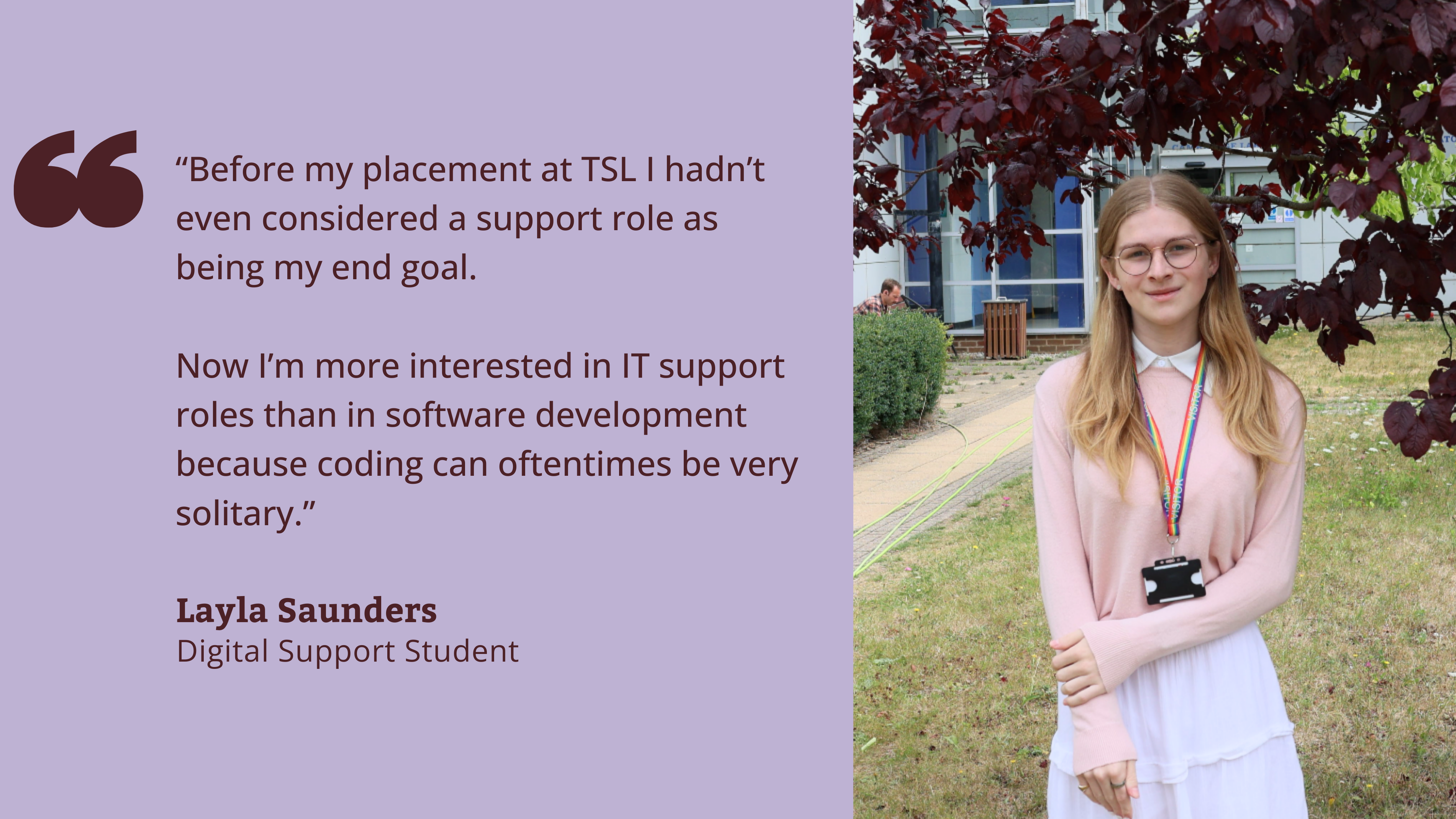
I entered my T level thinking that if I didn't like it, there would always be the option to move to university or into a different type of job. Strangely, before my placement at TSL I had not even considered a support role as being my end goal. After experiencing it, it is something I definitely would like to do as a job. Now I’m more interested in IT support roles than in software development because coding can oftentimes be very solitary.
My work placement meant that I didn't have to gamble a year on something that I might not like, and it gave me that assurance that I would really enjoy this type of work. I'm more sure of myself and work requirements on recruiting sites don't sound so intimidating anymore because I know that these things were quite easy to pick up. I’m keen to keep working in IT support, and I think that my six weeks of experience at TSL has made me a much stronger candidate when applying for jobs. I believe that for this kind of role, work experience is really the best form of education.
Do you have any advice for T level students?
My advice would be to consider work placement options that are different to what you've been exposed to before, even things that you wouldn’t necessarily expect to do as a full-time job. As I said before, working as IT support was not something I had originally thought that I would want to do after college. But after giving it a try, it's something that I really want to do now. So my advice is to give a chance to unexpected options, and to keep an open mind.
-----
Our IT Services Manager and Layla’s supervisor, said “As our first T-Level experience, Layla set the bar high. Her fresh perspective and thoughtful questions inspired me to reflect on my own practices, and she reminded me just how valuable it is to support and learn from emerging talent. She didn’t just gain from the experience — she contributed meaningfully to our wider support team and left a lasting impact."
"Layla has a bright future ahead in the digital world, and I’m proud we could be part of her journey. I also feel genuinely better for having had the chance to mentor her — she inspired us just as much as we hope we inspired her.”