The Sainsbury Laboratory receives support from Google.org for AI science research
The initiative will harness AI to better understand agriculture and strengthen food systems
By Laura Turchi and Mia Cerfonteyn in collaboration with Google.org
Norwich, UK, 26 January 2026 – The Sainsbury Laboratory is delighted to announce that it has received $2 million in funding as part of Google.org's $20 million AI for Science Fund to support organizations focused on cutting-edge AI for science research. The funding has been awarded to twelve academic and nonprofit organizations around the world that are using AI to address increasingly complex problems at the intersections of various disciplines of science.
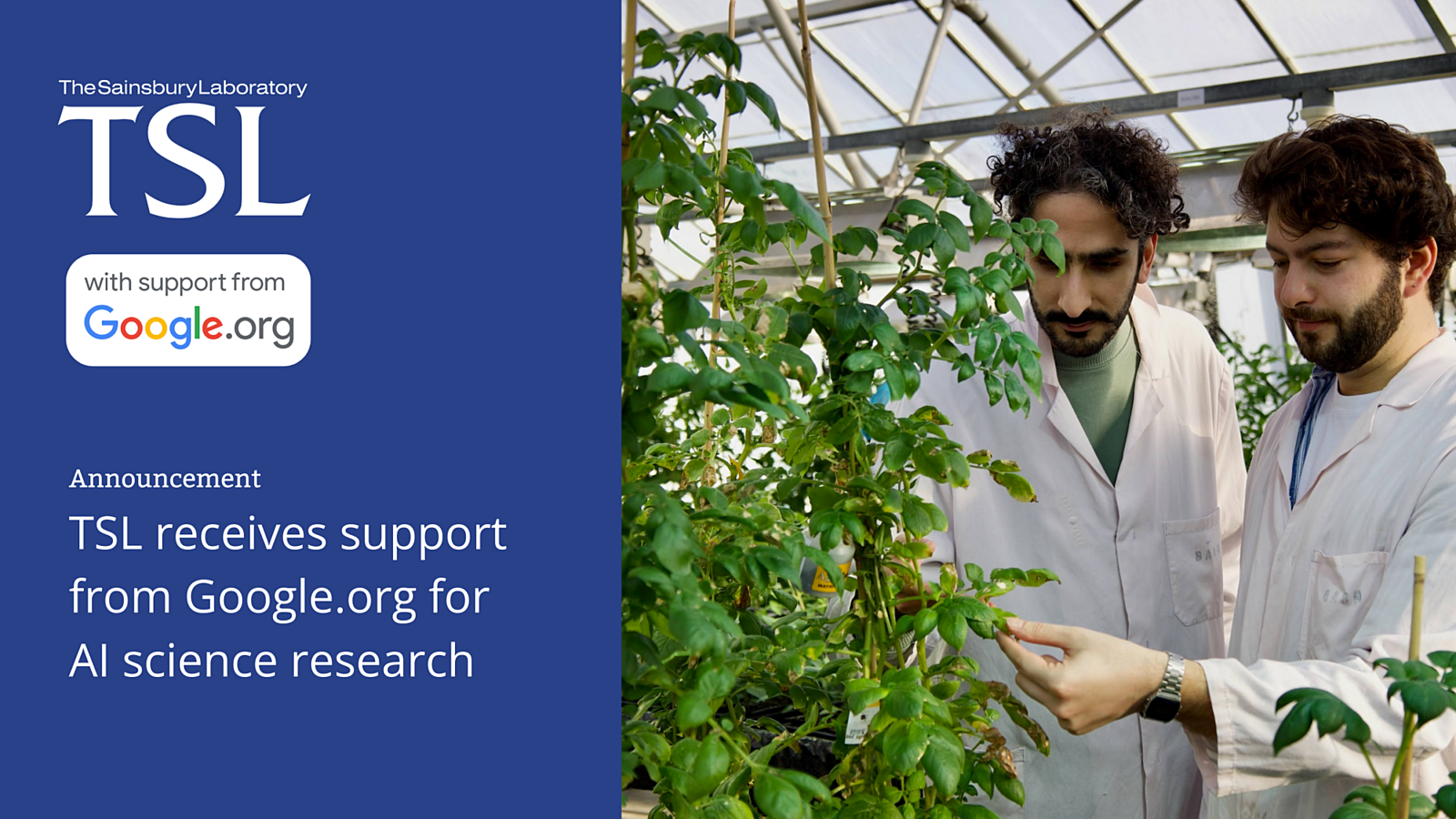
AmirAli Toghani (left) and Andres Posbeyikian (right) inspecting a potato plant as part of a research trial in our glasshouse.
Google.org is excited to support The Sainsbury Laboratory as they leverage AI towards achieving scientific breakthroughs, and plans to continue funding meaningful initiatives that exemplify AI's ability to enable science at digital speed.
“We’re giving researchers the resources to fast-track AI breakthroughs, achieving in years what once took decades." said Leslie Yeh, Google.org’s Director of Scientific Progress. "The AI for Science fund is supporting twelve organizations who are using AI to tackle some of the world's most complex scientific challenges like disease prevention, protecting our food systems and mapping the natural world."
Read the Google.org announcement
The funding will launch Bifrost, an ambitious research and technology initiative designed by Professor Sophien Kamoun and his team, which uses DeepMind's AlphaFold3 to predict how plant immune receptors interact with pathogens based solely on genome sequences, accelerating the breeding of disease-resistant crops.
Sophien Kamoun says: “The generous support from Google.org opens a truly exciting opportunity to scale our AlphaFold screening capabilities and predict millions of protein-protein interactions between pathogens and host plants. By extracting deeper insights from genome sequences, we aim to accelerate the discovery of novel disease-resistance genes—a critical step in developing the next generation of resilient, high-yield crops.”
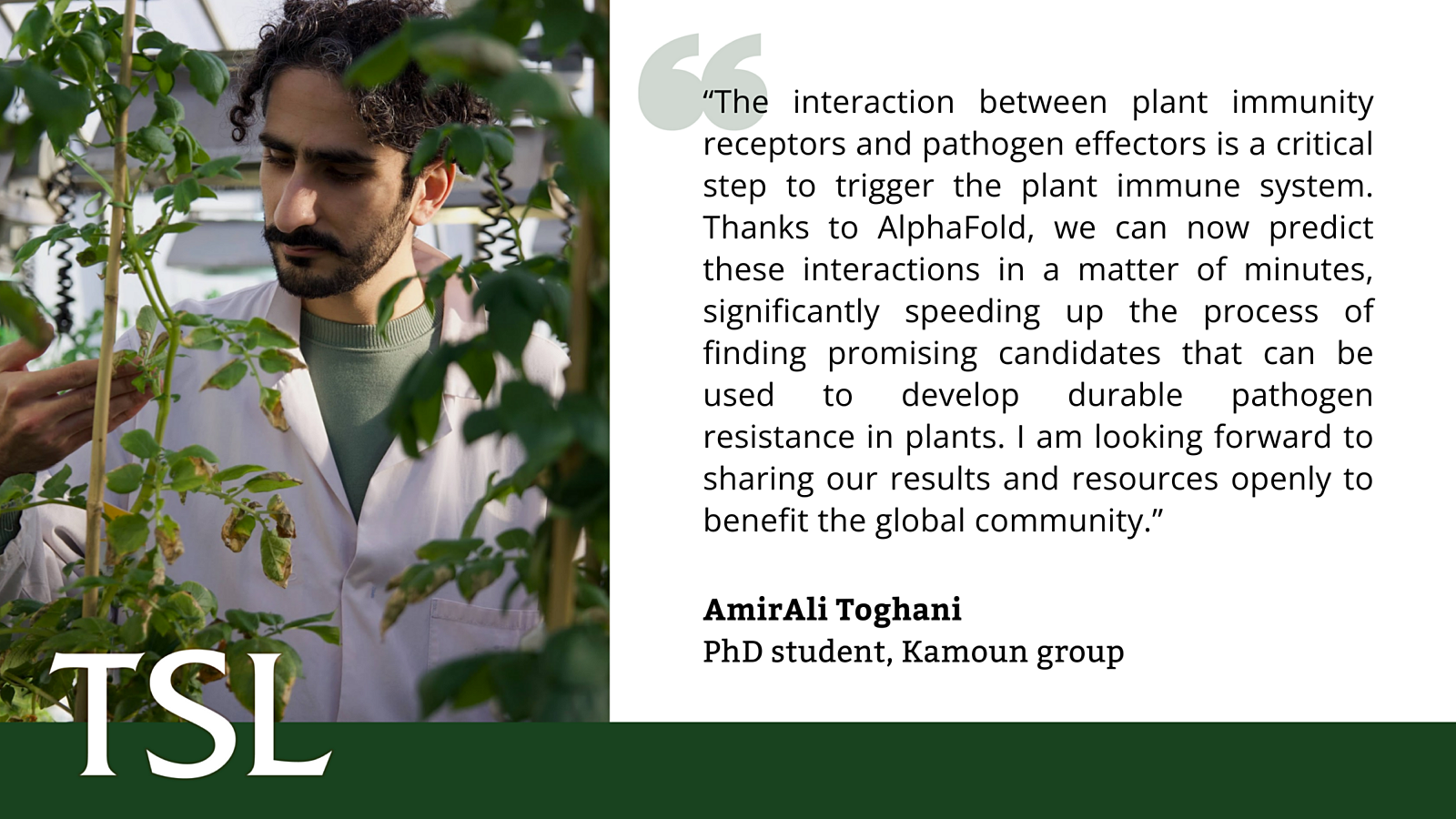
Bifrost brings together plant science, data science, and responsible AI methods to address one of agriculture’s most pressing challenges: protecting crops from pathogens amid climate change and increasing global demand. PhD student AmirAli Toghani will develop a pipeline for AlphaFold-enabled screening of protein-protein interactions to develop resilient plant varieties at an unprecedented speed.
A cornerstone of Bifrost is its commitment to open science. All methods, datasets, and tools developed through the initiative will be freely accessible on open science platforms, fostering collaboration across borders. Once a successful pipeline is established to accelerate the development of disease-resistant crops, it will be integrated into existing breeding programs, boosting disease-resistance efforts and reducing reliance on chemical pesticides. This pathway is designed to translate research outputs directly into practice, enabling tailored crop development across regions and crop systems.
Bifrost marks a significant step toward a future where scientific innovation is open, inclusive, and capable of safeguarding food security worldwide through shared knowledge and equitable access to advanced technologies.
For press information, you can contact TSL Communications - mia.cerfonteyn@tsl.ac.uk