Plants mimic pathogen target as a decoy for detection
Scientists have discovered direct evidence that immune receptors can evolve by mimicking effector targets and used that insight to engineer a disease-resistance gene capable of recognizing two major crop pathogens.
This new publication was authored by scientists from The Sainsbury Laboratory (TSL) and the John Innes Centre (JIC) in Norwich, UK, in collaboration with the USDA–University of Minnesota laboratories in the USA.
“This breakthrough discovery led by Diana Gómez de la Cruz and Matt Moscou has revealed how molecular mimicry can be used by plants to defend themselves against pathogen attack. Using the new tools of computational structural modelling, we have an opportunity to harness this discovery to develop completely new durable resistant crops in future. It is very exciting.” — Prof. Nick Talbot FRS, co-author and TSL's Executive Director
A central character in this story is the blast fungus, Magnaporthe oryzae, one of the world’s most destructive plant pathogens which targets many important cereal crops such as rice, wheat, and barley. Rice blast disease, for example, is estimated to destroy enough of the world’s rice harvest each year to feed approximately 60 million people, posing a persistent threat to global food security.
The published study was built on a long-term research effort in Matthew Moscou’s group at The Sainsbury Laboratory (TSL), now based at the USDA-ARS Cereal Disease Laboratory. First author, Diana Gómez de la Cruz, carried out the research first during her PhD in the Moscou group and later as a postdoctoral researcher in Nick Talbot’s group at TSL.
A key starting point for the project came from earlier studies at TSL showing how barley can recognise the blast fungus. While working together in the Moscou group, Helen Brabham and Diana demonstrated that the barley immune receptor MLA3 provides resistance to M. oryzae by detecting the fungal effector Pwl2, a virulence protein secreted during infection (read paper here).
plant cells detect and defend
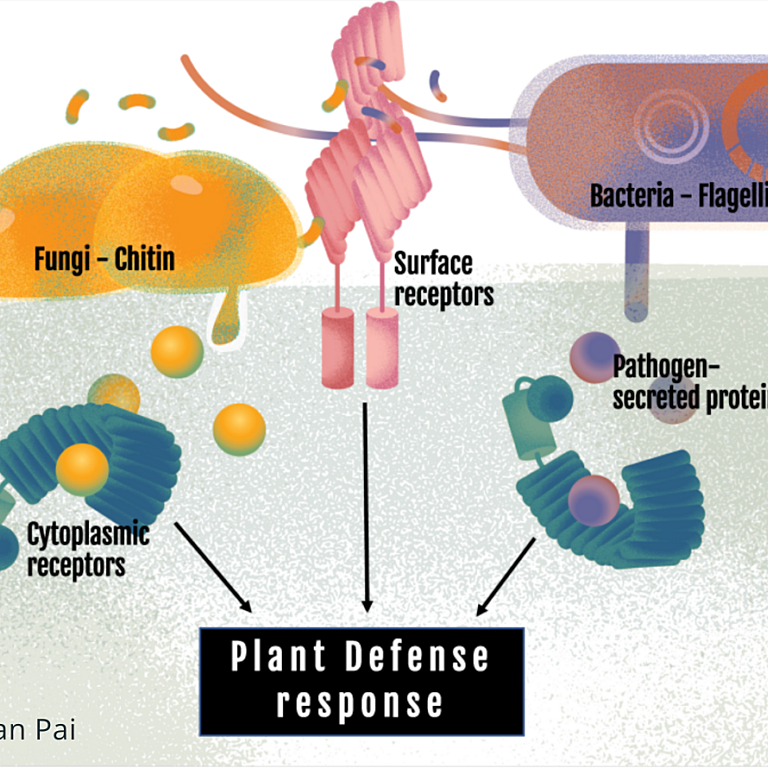
Plants can detect pathogen invasion through specialised immune receptors that recognise pathogen-secreted proteins called effectors. Unlike mammalian immune systems that adapt upon pathogen exposure, plant immunity relies on evolution to gain new recognition capabilities and protect against emerging diseases.
But how do plants actually evolve new recognition capabilities?
In parallel, research led by Vincent Were in Nick Talbot’s group, along with Rafał Zdrzałek in Mark Banfield’s group at JIC, revealed that Pwl2 targets a specific plant protein during infection to manipulate the plant and facilitate invasion. Together, these findings provided a foundation for investigating how MLA3 recognises Pwl2 at the molecular level (link to Vincent's paper, link to Rafał's paper).
Then, a breakthrough came with the arrival of AlphaFold, the artificial intelligence system that revolutionised protein structure prediction.
Diana used AlphaFold to model the MLA3–Pwl2 complex to better understand how the receptor recognises the fungal effector, while in parallel Rafał had experimentally solved the structure of Pwl2 bound to its plant protein target.
When the predicted and experimental structures were compared, their striking similarity immediately stood out, prompting the idea that MLA3 might be mimicking the very plant protein targeted by the pathogen.
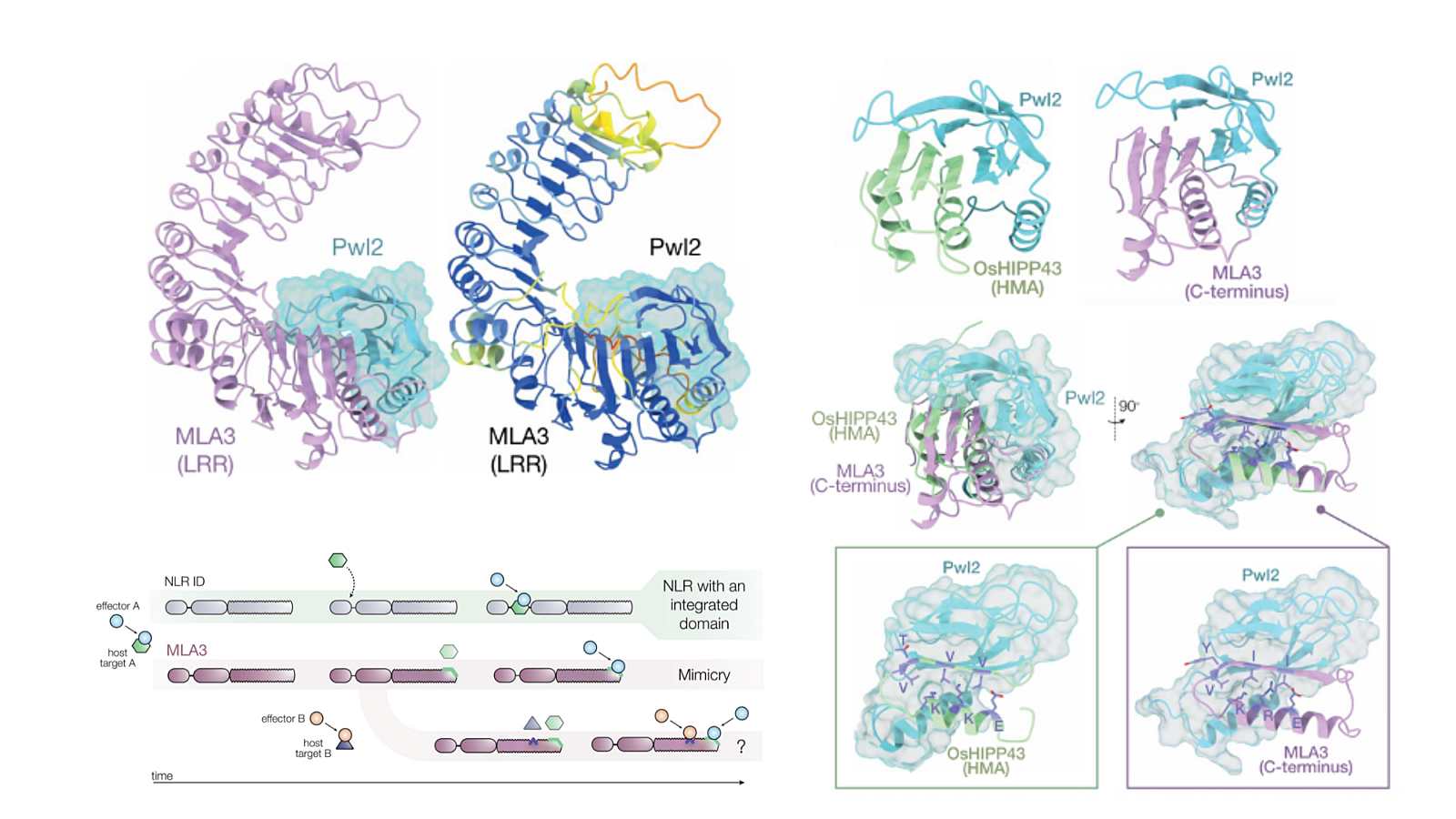
AlphaFold2 structural predictions and model of molecular mimicry strategy. From Gómez de la Cruz et al. (2026)
Competing for the same binding interface
During a TSL seminar discussion, postdoctoral researcher Jack Rhodes raised the question of whether the plant target protein influences MLA3 recognition of Pwl2. Follow-up experiments confirmed this: the presence of the plant protein reduced MLA3-mediated recognition of the effector, consistent with both proteins competing for the same binding interface.
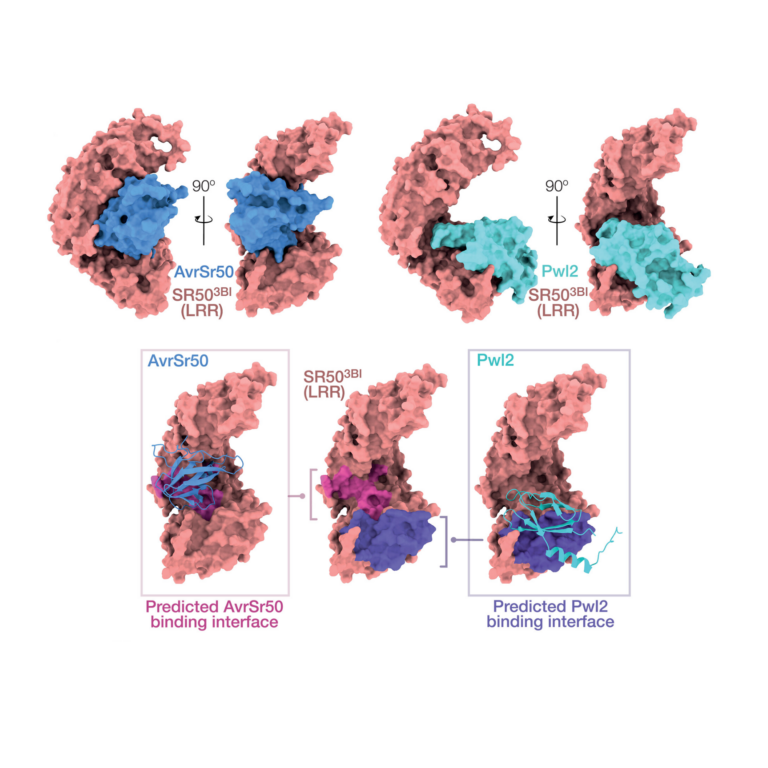
Together, the structural and functional observations converged on a novel mechanism: MLA3 has evolved to mimic the plant protein targeted by Pwl2, allowing it to intercept the fungal effector and trigger immune responses.
In effect, the immune receptor uses molecular mimicry to turn a pathogen strategy against itself. This provides direct evidence that mimicry of host targets can drive the evolution of new pathogen-recognition specificities in plant immune receptors.
This mechanistic insight also opened the door to engineering
By identifying the molecular interface responsible for Pwl2 recognition, the researchers transferred this binding surface into a related immune receptor, SR50, found in rye.
Unlike MLA3, SR50 naturally confers resistance to wheat stem rust, another major cereal disease. Integration of the specific molecular mimicry interface from the barley receptor generated a chimeric receptor capable of recognising both stem rust and blast pathogens.
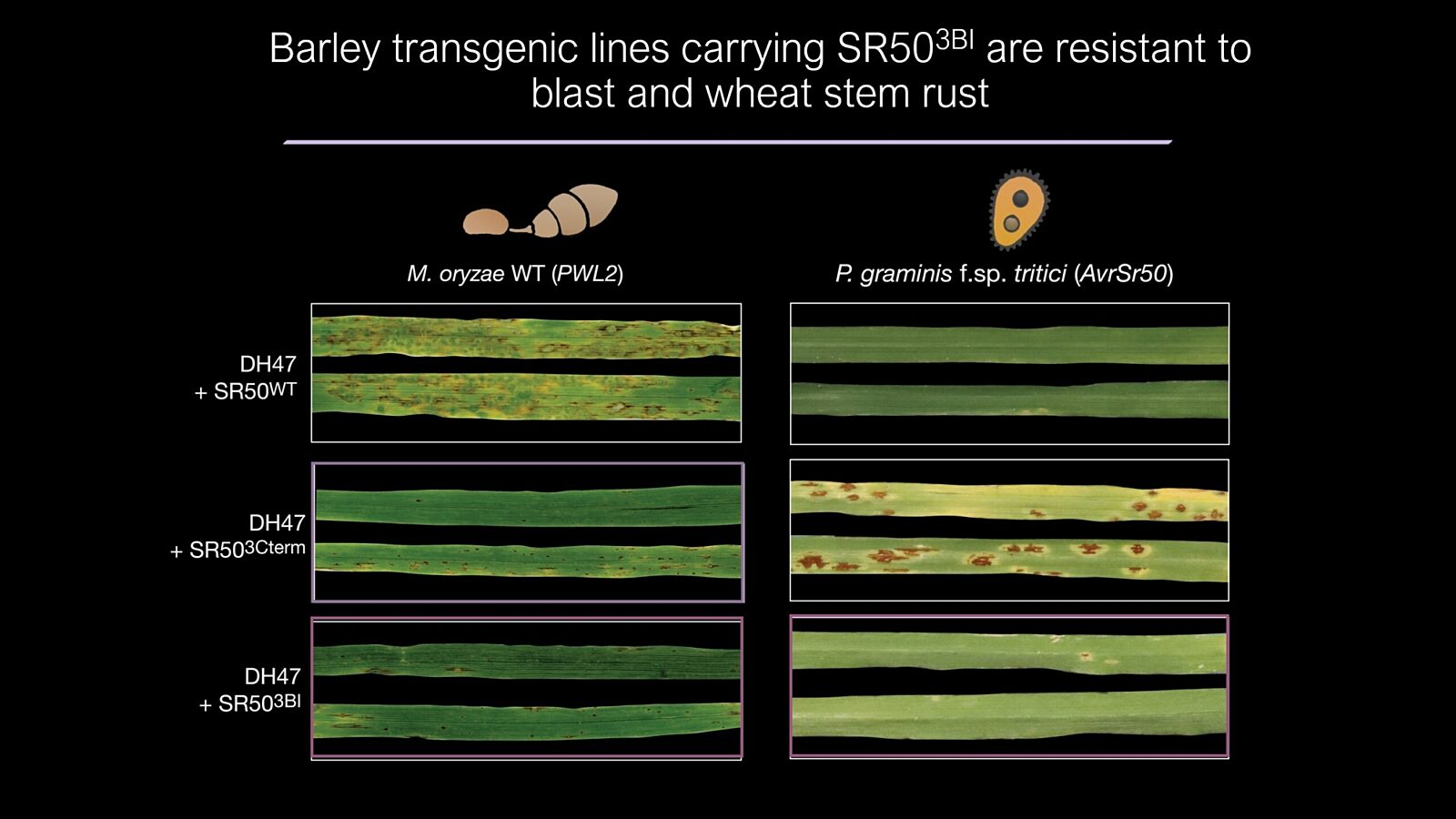
These predictions were validated in engineered barley lines grown in Minnesota and Norwich, which showed resistance to both diseases. This dual-recognition system provides a promising framework for developing crops with broader and more durable disease resistance.
Diana says: “This project highlights how long-term fundamental research and collaboration across groups and institutions can uncover basic biological principles and translate them into practical solutions for agriculture.”
Diana gives a special thanks to Tom Ingram, Rafał Zdrzałek, Mark Banfield, TSL's Tissue Culture and Transformation team, and her supervisors Matthew Moscou and Nick Talbot.
You can read Diana's own summary of the paper here: @dianagdlc.bsky.social