Community Spirit: Plasmids for All
How a decade of plasmid-wrangling at The Sainsbury Laboratory grew into a movement — and the unexpected friends now helping us open the doors wider.
by Sophien Kamoun, first published on Medium.com
Every big idea in molecular biology eventually comes down to a small loop of DNA. You want to express a protein, tag a gene, edit a genome, wire up a circuit — and there it is, waiting: a plasmid. Unglamorous, quietly indispensable, and at times tricky to build. Plasmids are the workhorses of the lab, and like most workhorses, they only get noticed when something goes wrong.
At The Sainsbury Laboratory (TSL), we decided long ago to invest in the art of building plasmids. If we wanted our science to move fast, stay reproducible, and leave room for the occasional wild idea, we had to treat plasmid support as infrastructure rather than an afterthought. So over a decade ago we built our SynBio platform to give the lab expert plasmidology support: a place to design, build, troubleshoot, and share the DNA tools modern biology runs on.
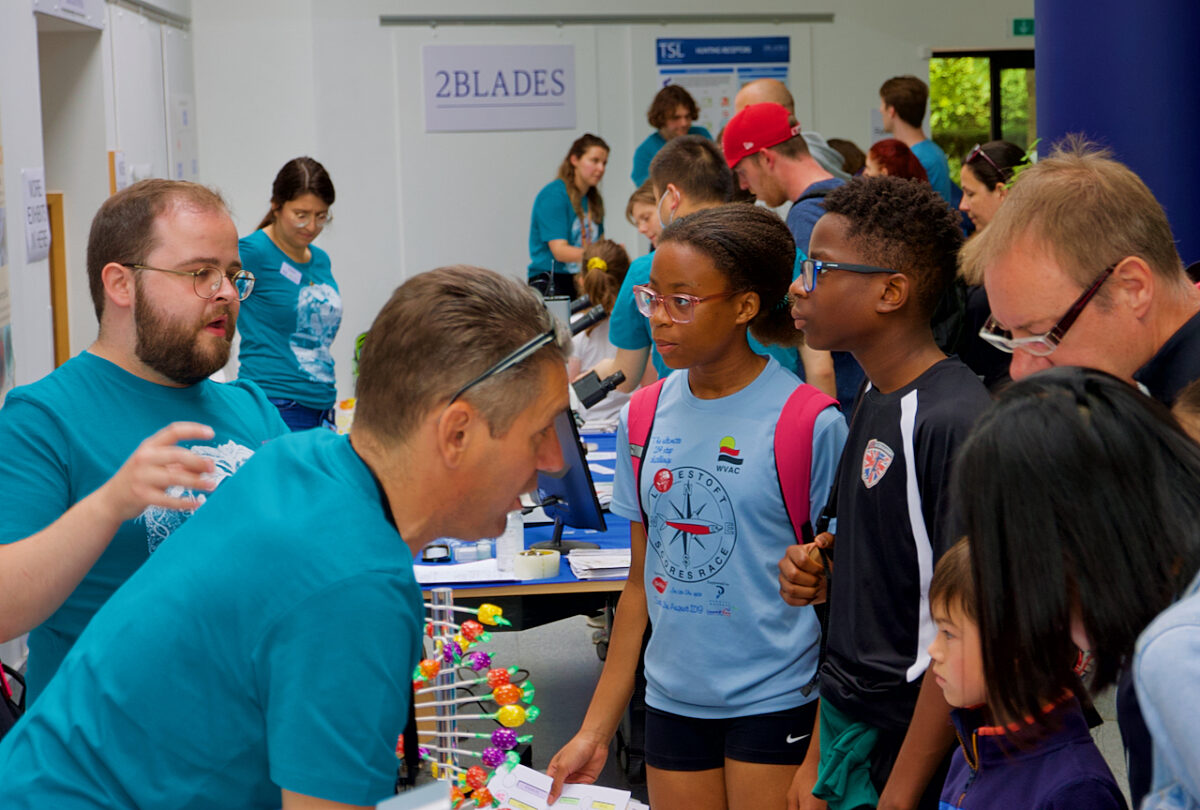
When they’re not in the lab building plasmids, Mark Youles and Liam Egan love inspiring younger generations. Here, they are using lollipops to explain DNA structure. Photo by Steph Bornemann.
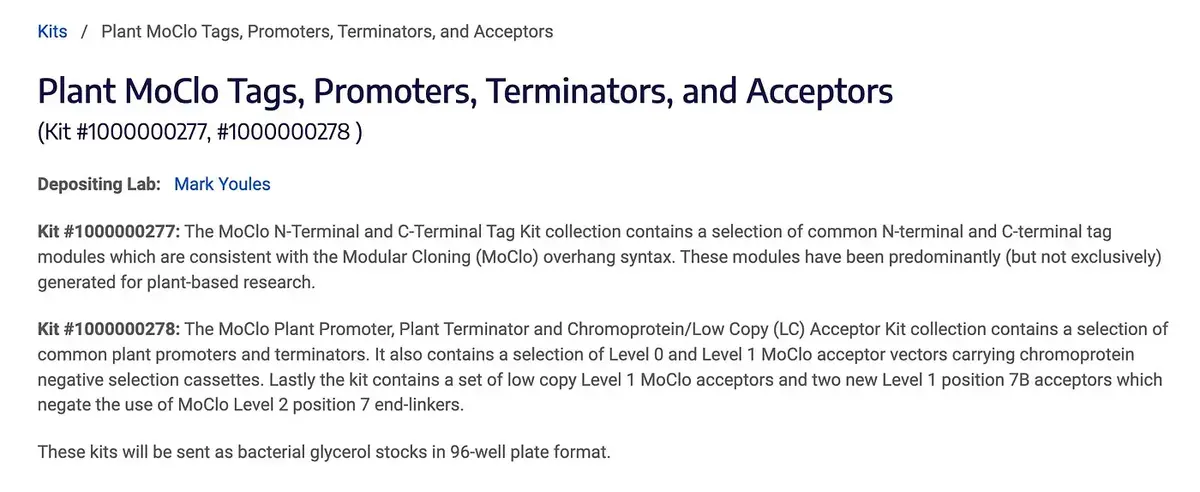
Mark Youles and Liam Egan have been quietly outstanding at this, helping generation after generation of TSL scientists turn a rough plan into a working construct. And we don’t keep it to ourselves. Their latest move: two more microplates added to an already formidable public collection of 1,533 Plant MoClo plasmids deposited in Addgene, openly available for anyone, anywhere, to request. That number represents a decade of careful building, handed to the community with the instructions included.
But good science doesn’t stop at the walls of one institute.
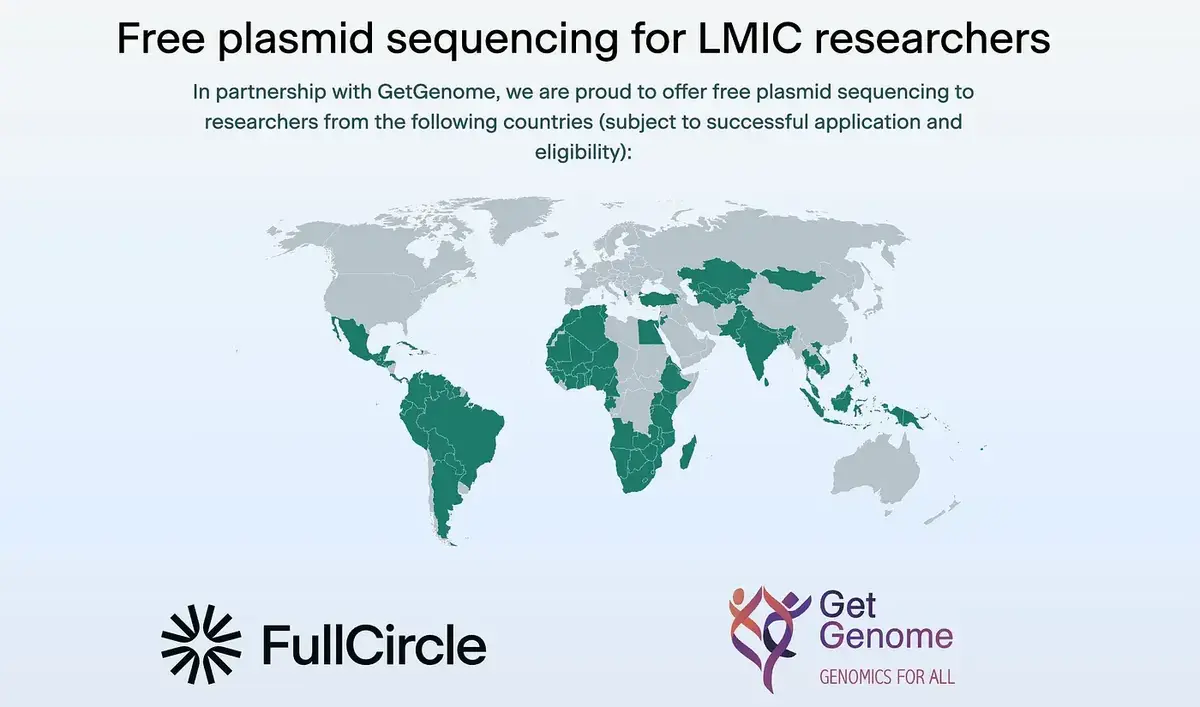
A few years ago, James Canham and I started asking a bigger question: how do you scale this kind of support beyond a single building? That question became GetGenome — our nonprofit initiative, now a registered UK charity, to widen access to genomics, training, and the enabling technologies that too often depend on your postcode. Today GetGenome supports a network of 150+ scientists across 100+ institutes in more than 20 countries, including free plasmid sequencing for researchers in around 100 low- and middle-income countries. The idea is almost embarrassingly simple: remove the friction, open the door, and let good science happen wherever curiosity and talent turn up — which, it turns out, is everywhere. (If you want to keep tab, our new wiki tracks the projects so far, sequence data and publications included.)
What's genuinely moving, is that this spirit keeps attracting company.
We recently teamed up with Full Circle Labs, a Certified B Corporation that turn out to share our stubborn belief that access to core technology shouldn’t be gated by geography, institutional wealth, or who you happen to know. Together we are doubling up on offering free whole-plasmid sequencing to researchers across roughly 100 countries — you send the plasmid, we sequence it, and you get the data plus the training to read it. Quality control shouldn’t be a luxury item.
Never sequenced a plasmid before? We wrote a friendly guide to why you should — and how to do it for free.
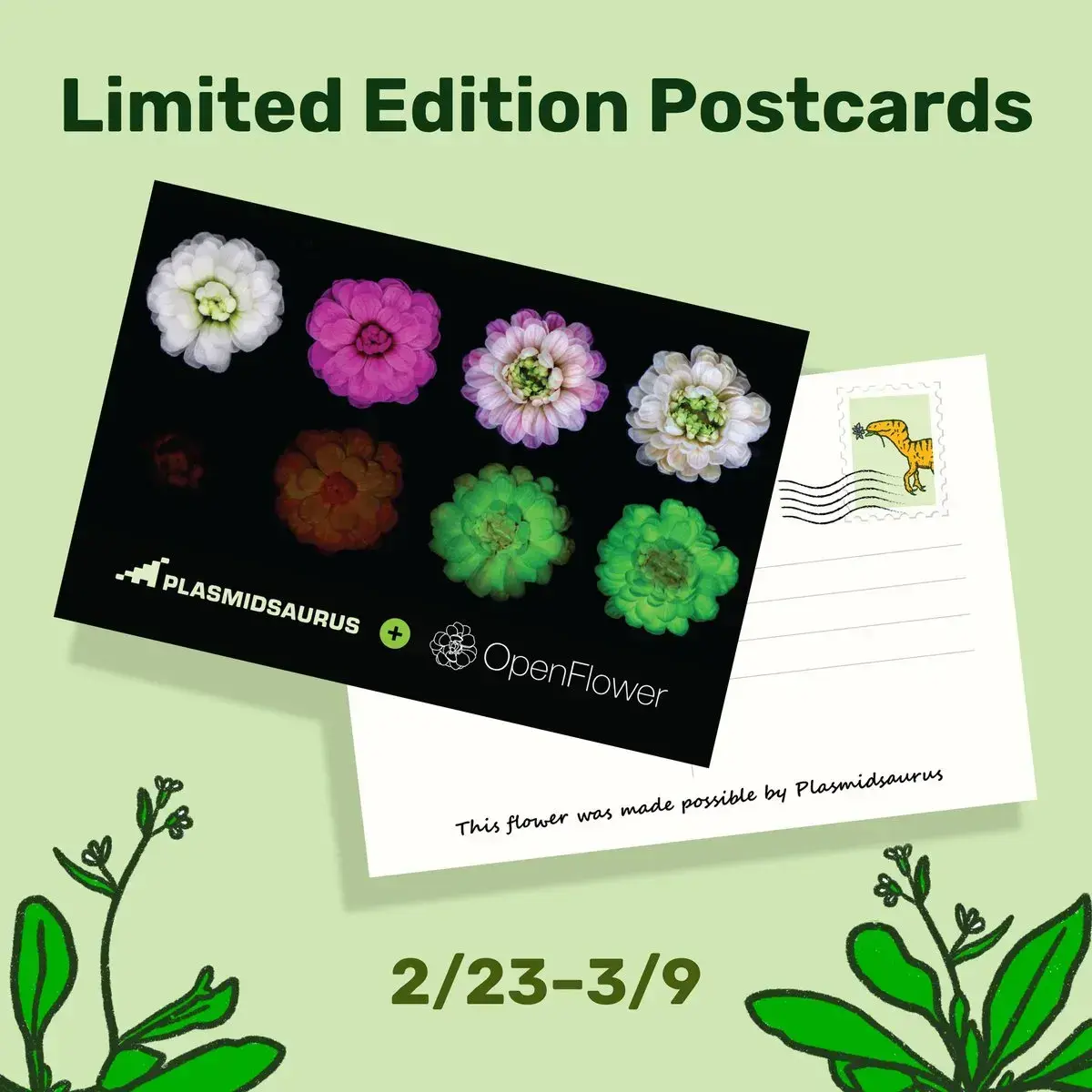
The same energy runs through OpenFlower, the project led by Nick Desnoyer. Nick is building something joyful and audacious: a platform where biology meets creativity, gardening, design, and public participation — including ornamental flowers bred as living public outreach. Because community support isn’t only about helping professional scientists hit their deadlines. It’s also about pulling students, artists, gardeners, tinkerers, and curious passers-by into the orbit of living systems, and letting them play.
Nick’s reach has grown to the point where he is, no exaggeration, a bona fide biology influencer — and sponsors have started to notice. Companies like Plasmidsaurus and Genewiz understand that backing open, creative, community-driven biology isn’t charity. It’s an investment in the future of the field — and in the next generation, who’ll decide whether biology feels like a gated fortress or an open garden.
That’s really the whole point. From a bench in Norwich to a lab in Nairobi to a windowsill full of engineered flowers, the same little loop of DNA keeps showing up — and the same instinct keeps paying off: Build the tools, then give them away.
To Mark, Liam and the SynBio team, to the GetGenome network, and to Full Circle Labs, Plasmidsaurus, and Genewiz — thank you. You’re the proof that “plasmids for all” was never just a slogan.
So stay tuned. Better still, join us.
Whether you’re a sponsor, a funder, a philanthropist, a scientist, an artist, a gardener, or simply a curious mind with a question you can’t shake — there’s room in this. Plasmids for all is a way of doing biology: generous, open, practical, and wide awake to what becomes possible when we build with and for the community.
The door’s open. Bring a plasmid. Join a community. Support a scientist.
Acknowledgments
I am grateful to the colleagues and sponsors who are mentioned in this article for their contributions. This article was written with assistance from Claude (Anthropic) and ChatGPT (openAI).
Cite as
Kamoun, S. (2026). Community Spirit: Plasmids for All. Zenodo. https://doi.org/10.5281/zenodo.21280983