Making Plant Research More Green
Green Impact Awards 2025
At The Sainsbury Laboratory, we are committed to reducing our environmental impact while continuing to deliver world-class research. That’s why we’re proud to have taken part in the Green Impact scheme for a second consecutive year, alongside our partners at the Norwich Bioscience Institutes (NBI).
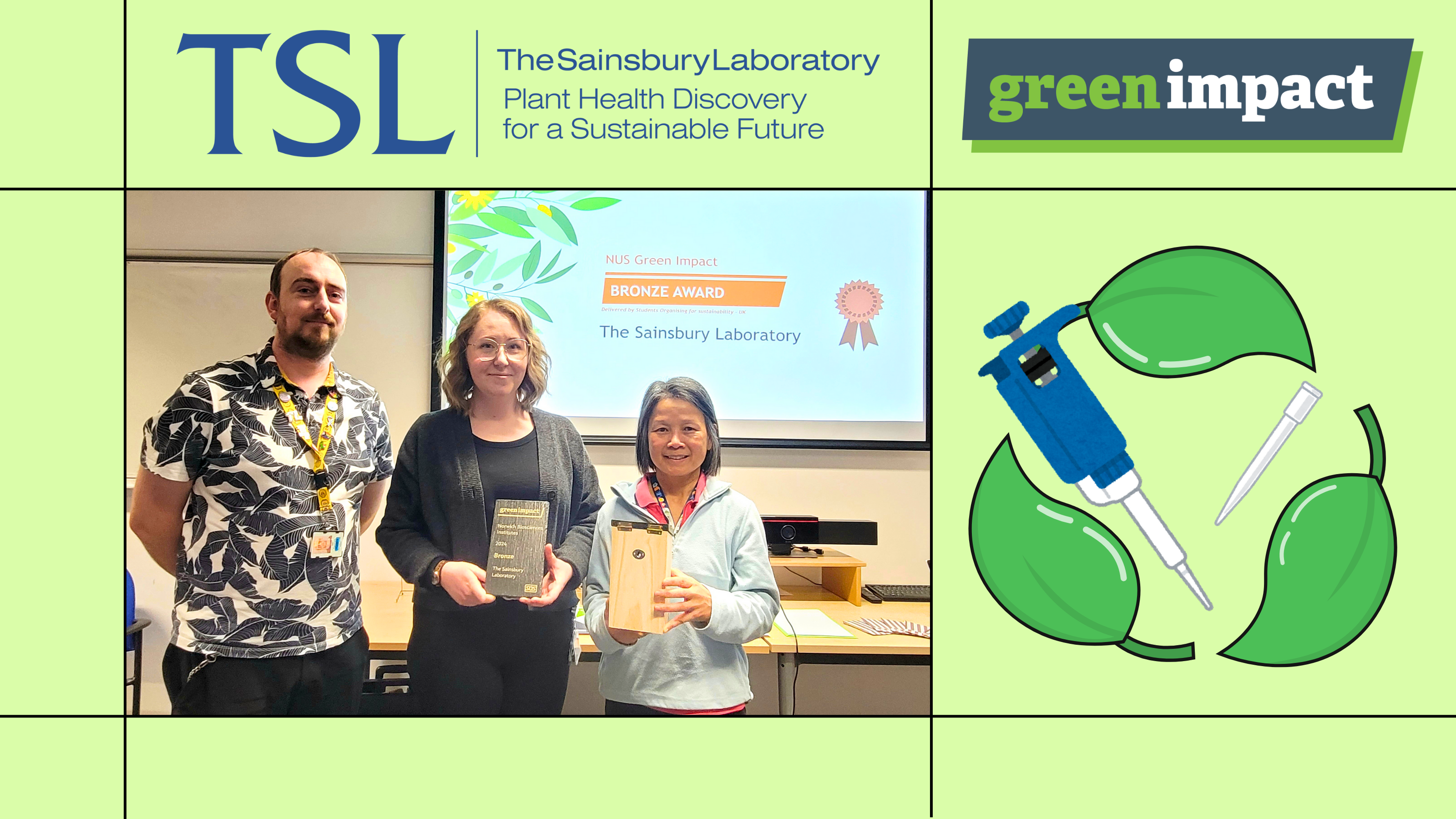
Neil Stammars, Shona Strachan and Phon Green represented TSL during the presentation of our Bronze award.
Scientific research is a resource-heavy field
According to the LEAF website, it’s estimated that laboratories are responsible for around 2% of global plastic waste and use 3-10 times more energy per meter squared than a typical office.
Green Impact is an international sustainability scheme where teams of staff and students work through sector-tailored actions and projects, achieving awards as they go.
Starting with the John Innes Centre (JIC) three years ago, participation in Green Impact has rapidly expanded across the NBI campus—growing from 129 completed sustainability actions by two teams to an impressive 478 actions across eight teams.
Green Impact has facilitated some truly remarkable collaborative sustainability efforts over the past three years and showed that small actions, when done on mass, can have a fantastic wider impact.
This year, The Sainsbury Laboratory started using a pipette tip washer to reduce otherwise single use lab plastics, saving 5L water and 1.8 kg CO2 per tip rack (over the manufacturing of new tips).
In addition:
- Two teams from the John Innes Centre focused on different aspects of sustainability. The Biodiversity Project team decided to focus their efforts on recording, promoting and supporting biodiversity on site, including recording species at Church Farm in Bawburgh. The second team, based in the Chatt Building, took part in a range of lab, office, and facilities-based actions, and hosted an energy sustainability exhibition, bringing institutes and departments together to share information, tips, and best practice. A traffic light sticker system was also introduced to help lab users switch items off.
- Earlham Institute participated in the ‘Freezer Challenge’, replacing inefficient freezer units with eco versions, changing the ultra-low temperature freezers from 80˚C to 70˚C where possible, and clearing out over 700,000 old samples. This challenge alone resulted in a huge 256 kWh per day saving in energy usage.
- Quadram Institute set up a textbook recycling scheme, which led to the reuse of over 200 textbooks from across all the institutes.
Ethne Clark, Energy and Environment Officer at NBI, said: “I’ve been thrilled to see how much our scheme has grown and how many passionate people have come together to improve sustainability across NBI. The science across our sites aims to improve the environment and people’s health, so it is great to see that we also live and breathe this mission in the day to day running of our site.”
Next year the NBI are taking part in a new scheme, LEAF, which stands for Laboratory Efficiency Assessment Framework and is led by University College London.
Award winners
The Sainsbury Laboratory is delighted to have won a Bronze award and look forward to incorporating more sustainability initiatives next year.
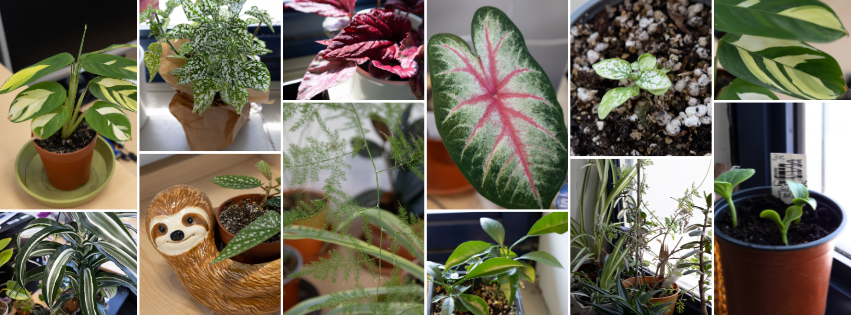
TSL was praised for our plant-filled offices - there's an obvious love for our photosynthetic friends. Note that this image only shows a small selection of what can be found in our offices.
We would also like to celebrate the fantastic achievements of our partner teams:
- JIC Chatt Building: Silver and Project awards
- JIC Biodiversity Project: Project award
- Building 26: Bronze award
- Facilities and Health, Safety, and Quality Assurance: Gold and Project awards
- Earlham Institute: Silver and Project awards
- Quadram Institute: Silver award
- NBI Students: Bronze award