Breakthrough study in plant immunity reveals previously unsuspected octameric resistosome
The wheat WAI3 receptor forms a novel defence-activating resistosome made of eight molecules, as revealed by an international collaboration led by The Sainsbury Laboratory
An international collaboration between researchers from The Sainsbury Laboratory (TSL), the Institute of Genetics and Developmental Biology (IGDB) in Beijing and CAS Center for Excellence in Molecular Plant Sciences (CEMPS) in Shanghai has made a groundbreaking discovery in plant immunity.
While studying an auto-active form of the wheat immune receptor WAI3 (Wheat Autoimmunity 3), the team identified a previously unknown structural architecture shared by a subset of immune receptors known as the “CCG10 clade.”
This clade includes well-known resistance genes like RPS2 and RPS5, which help Arabidopsis plants defend against the bacterial pathogen Pseudomonas syringae.
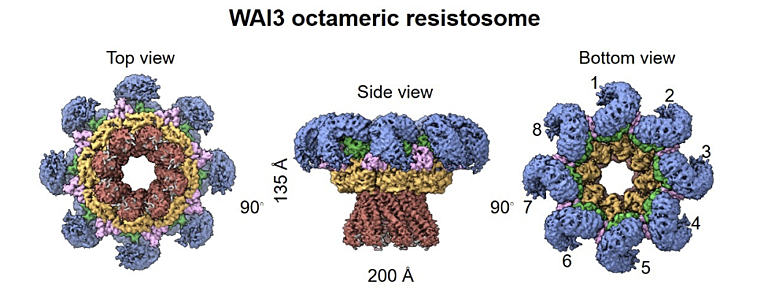
In a major scientific advance, researchers have found that the immune receptor WAI3 assembles into an octameric resistosome, a complex composed of eight receptor molecules. Using lower resolution methods, they showed this octameric configuration is also adopted by RPS2.
This discovery marks the first time such a structure has been observed, as previously identified resistosomes were limited to tetramers, pentamers, or hexamers, made of four, five and six receptors, respectively.
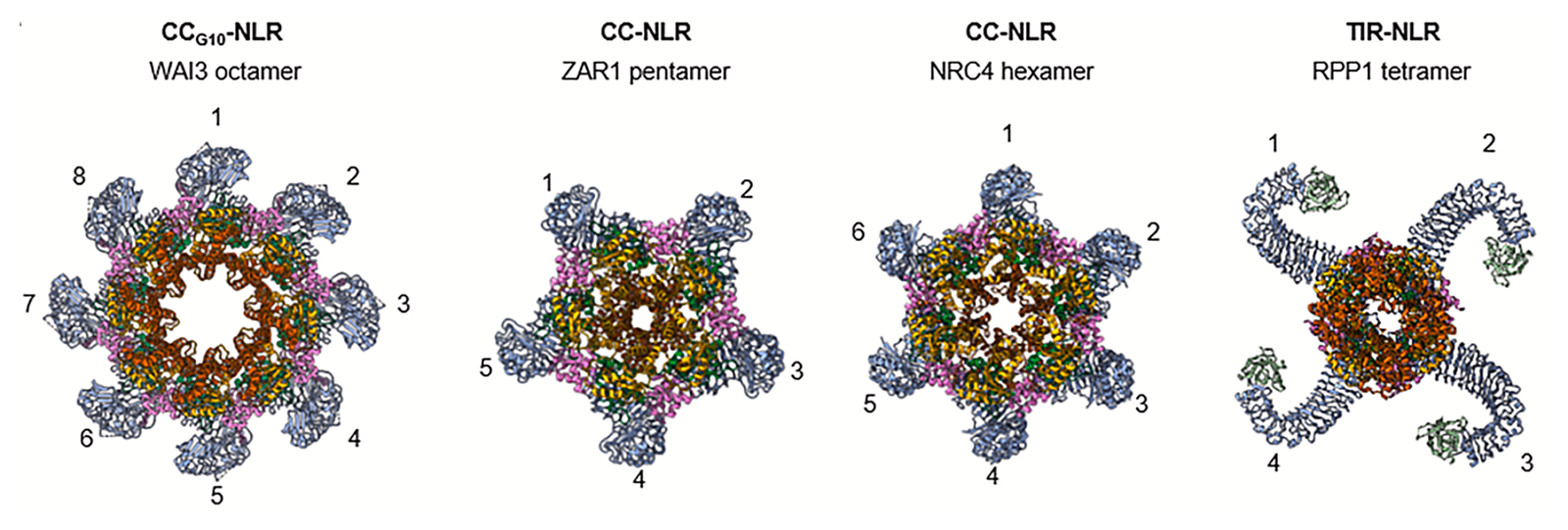
Using cryo-electron microscopy (cryo-EM), the researchers revealed that the activated WAI3 receptor assembles into this unique octameric structure. This architecture appears to be conserved across both monocot and dicot plants, suggesting a broader significance in plant immunity.
The WAI3 resistosome also triggers a sustained increase in cytosolic calcium influx in plant cells, a key immune response, through a novel channel architecture derived from its distinct coiled-coil (CC) domain configuration, a feature that might be shared by a large portion of CC-NLR immune receptors that lack the EDVID motif.
This finding not only sheds light on the plasticity of plant immune receptors but also opens new avenues for understanding how plants defend themselves against pathogens. By delivering critical insights into the structural diversity of immune receptors, this study can help pave the way for developing more resilient crops in the future.