A helper NLR challenges the membrane localisation dogma
A new study shows that NRG1, a helper NLR, can bind to chloroplasts to trigger plant immunity responses, challenging the prevailing view that resistosomes function only at the plasma membrane.
Publication: A helper NLR channels organellar calcium to trigger plant immunity
When it was first observed that NRG1 accumulates in organelles such as chloroplasts, the result was so unexpected that it was initially set aside. Then AlphaFold 3 came along, and NRG1-type resistosomes were consistently modelled with an extended “funnel” that could span the double membrane of organelles. Suddenly, what had seemed like an odd result started to make mechanistic sense.
This shift in understanding was driven by an international collaboration spanning Imperial College London, The Sainsbury Laboratory (TSL), the Bezos Centre for Sustainable Protein, and Academia Sinica.
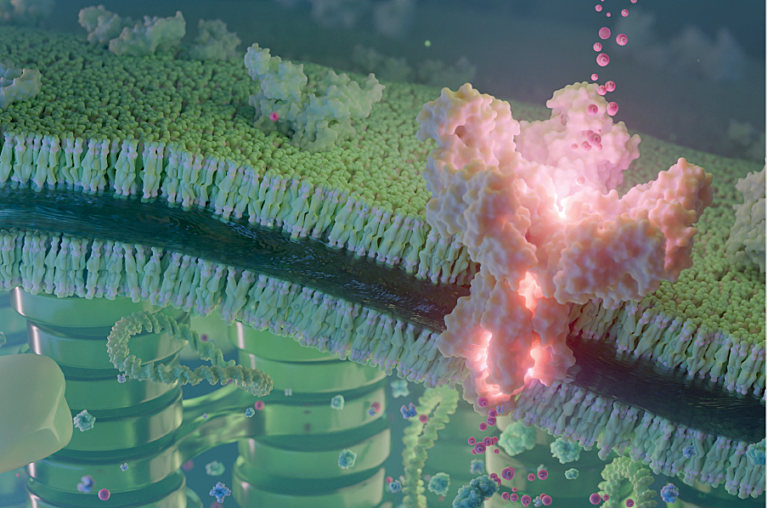
An artistic illustration of plant immune receptors (pink) targeting the chloroplast membrane and releasing the calcium stored inside. Image credit: Dr Verena Resch, luminous-lab.com
Unexpected observation confirmed by AlphaFold
"The prevailing view was that when plant immune receptors detect a pathogen, they assemble into pore-forming complexes at the plasma membrane and allow calcium to rush in from outside," says Tolga Bozkurt, TSL alumnus and co-corresponding author with TSL group leader Sophien Kamoun. "Our study shows that this is only part of the picture."
It was in Tolga Bozkurt’s lab at Imperial College London that early experiments suggested NRG1, a type of helper NLR, accumulates in organelles such as chloroplasts. Since these observations didn't align with the well-established understanding of plasma membrane localisation, it was interpreted as an odd result rather than a clue that we may not have the full picture.
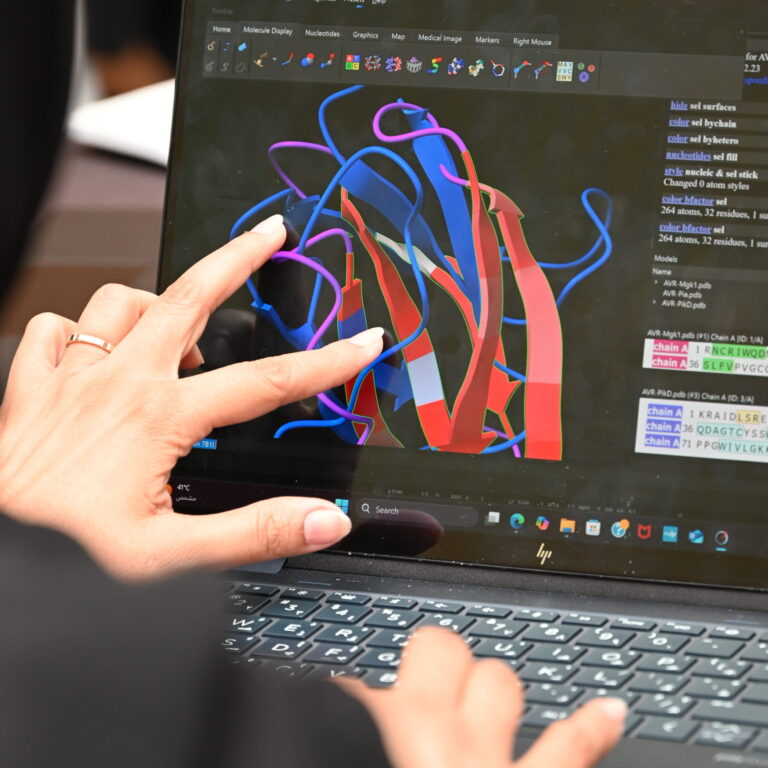
With the availability of AlphaFold3, a powerful AI tool that predicts how proteins fold, researchers started using this new tool to predict the structure of NRG1 resistosomes. Interestingly, AlphaFold3 predictions consistently revealed a funnel-shaped structure that could span chloroplast membranes.
Suddenly, Tolga and his team had a mechanistic explanation for their earlier puzzling results, leading them to reevaluate those initial findings and dig deeper into this special protein complex.
Further experiments confirmed that the NRG1 resistosome can form a channel that allows calcium to flow from organelles to the inside of the cell. Calcium acts as a rapid signal in plant cells, activating defence pathways and, in some cases, triggering the controlled death of infected cells to stop disease spread.
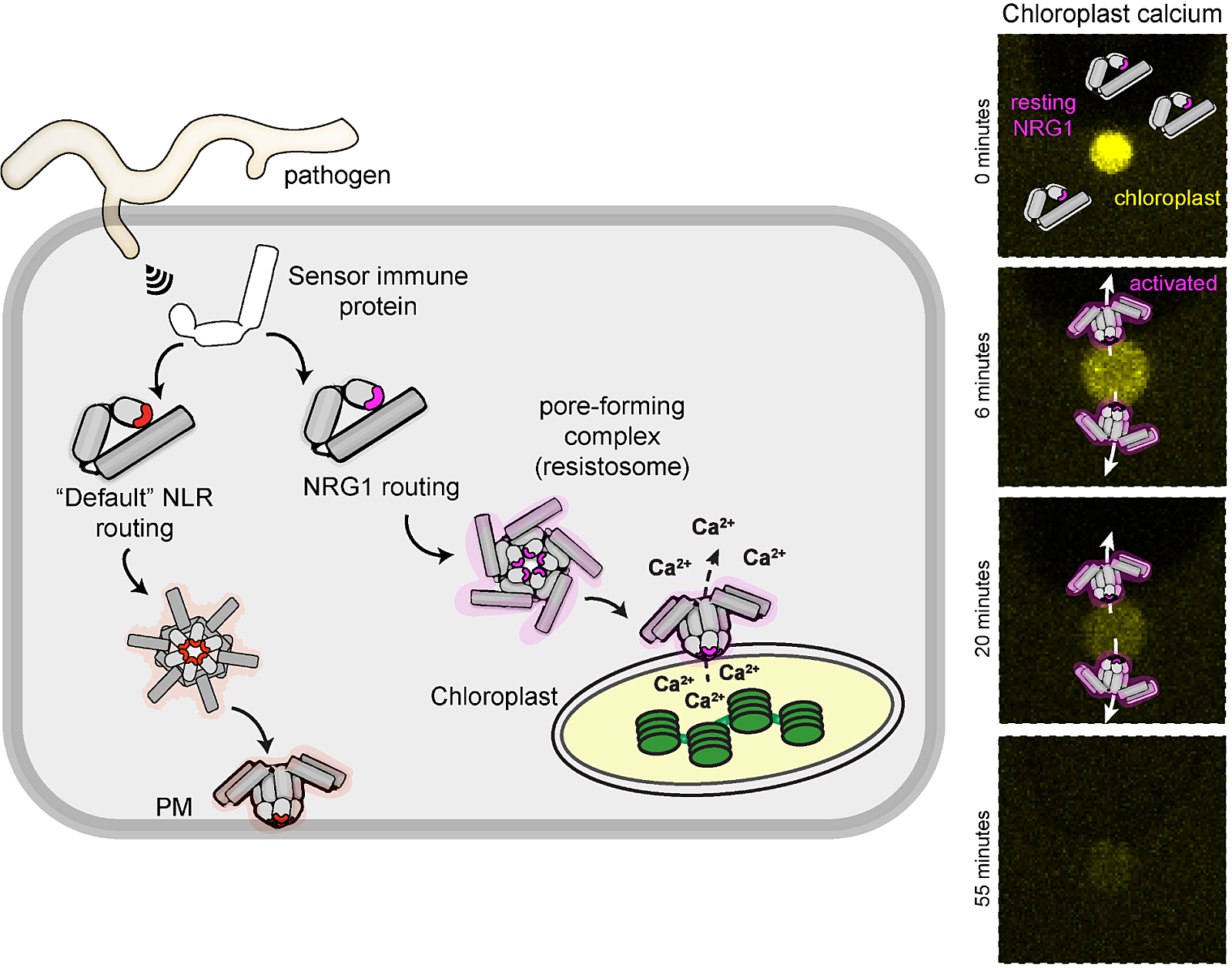
A new layer of plant immunity. Left: most immune receptors are sent to the cell's outer boundary (PM)| to let calcium flow in from outside (default system). Activated NRG1 receptors take a different route. targeting the chloroplast and releasing its internal calcium reserves. Right: live imaging shows activated NRG1 (magenta) docking onto a chloroplast (yellow) and draining its calcium store within an hour. Image credit: Tarhan Ibrahim
Another twist for NLR immune receptor biology
After confirming NRG1 can bind chloroplasts, the team were curious to explore whether this mechanism occurred anywhere else. They were excited to discover that similar proteins in the same NLR family also clustered at chloroplast membranes. This suggests that, although newly discovered, this mechanism of plant immunity may have been conserved over millions of years of plant evolution.
"Plant NLR immune receptors are astonishingly diverse—functionally and structurally," said co-author Sophien Kamoun, who is a group leader at The Sainsbury Laboratory. "This discovery shows we have only scratched the surface of what plant immunity can do, and there are clearly many more surprises in store."
Global Impact
This new study opens new avenues for exploring NLR roles in cellular immunity and shows how AlphaFold is revolutionising our ability to solve complex biological puzzles and open new pathways for developing crops with higher yields and a reduced reliance on pesticides.
The international collaboration underpinning this research, spanning multiple continents, brought together former TSL members such as Chih-Hang Wu, Jiorgos Kourelis, and Tolga Bozkurt.