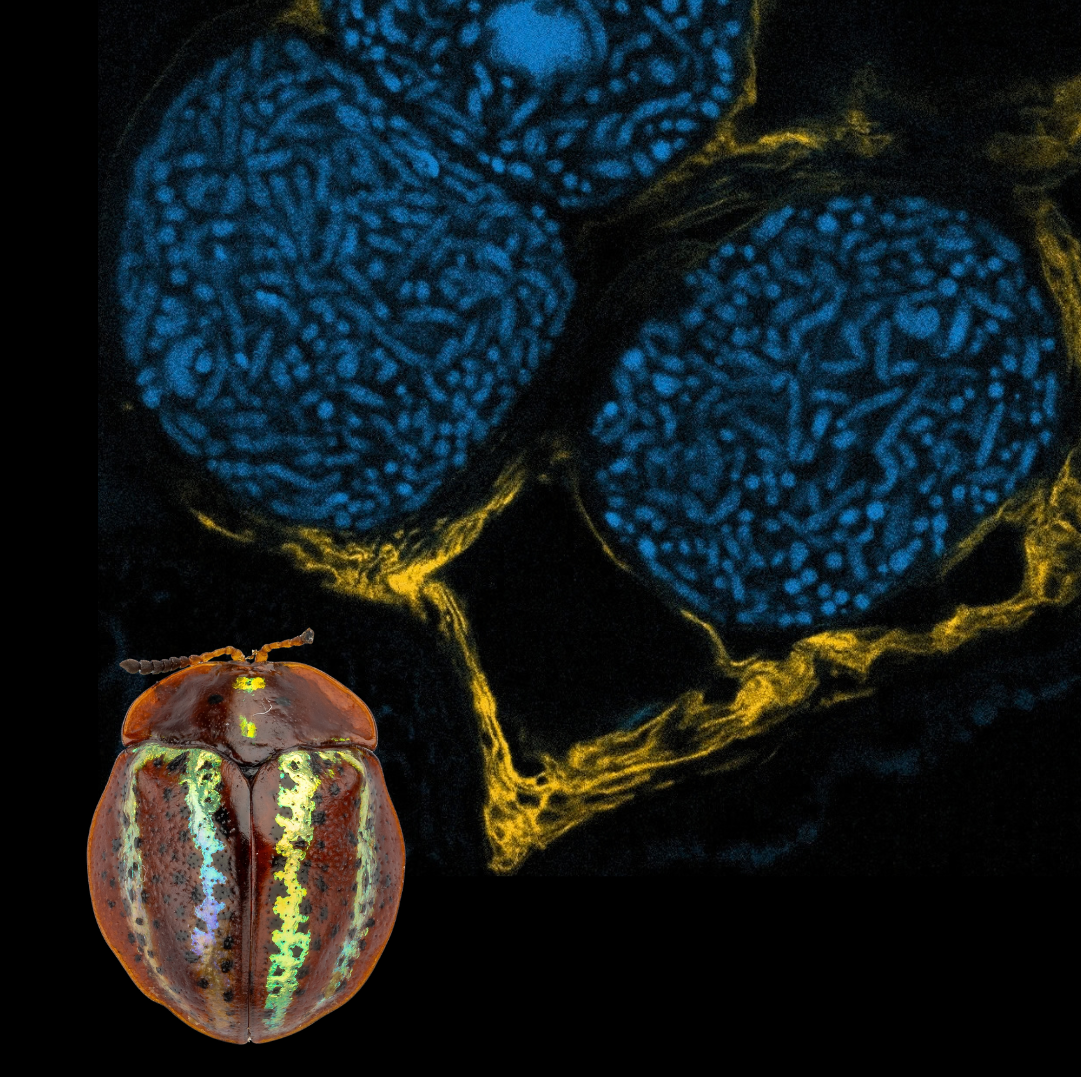
Tatsuya Nobori secures ERC Starting Grant to study plant immune cell states
NORWICH, UK — Tatsuya Nobori of The Sainsbury Laboratory has been awarded a highly competitive European Research Council (ERC) Starting Grant for his exciting new project, ImmuneCellStates. The project aims to redefine the framework of plant immunity, positioning immune cell states as its fundamental building blocks to pave the way for discovery in plant biology and crop engineering.
Dr Tatsuya Nobori, Group Leader, said: “This grant will give our research programme a major boost and allow us to pursue questions in plant immunity that we have been working towards since we established our lab at TSL two years ago. I am deeply grateful to the ERC, the reviewers and panel members involved in the selection process, and to my lab members and colleagues around the world whose work and ideas have laid the foundations for this project.”
Unlike animals, plants do not have specialised immune cells. Each plant cell, no matter its specialised role, must be capable of responding to a pathogen attack. When that happens, the cell enters an immune state to defend the tissue from the pathogen. These individual immune cell responses are the building blocks of plant immunity.
Tatsuya is on a quest to dissect this behaviour and understand the mechanisms behind immune states in plant cells, as their diversity, regulation, and function remain poorly understood.
A three-way strategy to study plant immune cell states
Thanks to recent advances in single-cell and spatial omics, regulatory genomics and genome editing, scientist now have new ways to understand how individual plant cells respond to infection.
ImmuneCellStates will bring these technologies together into a three-way strategy: Cell States, Regulation and Function.
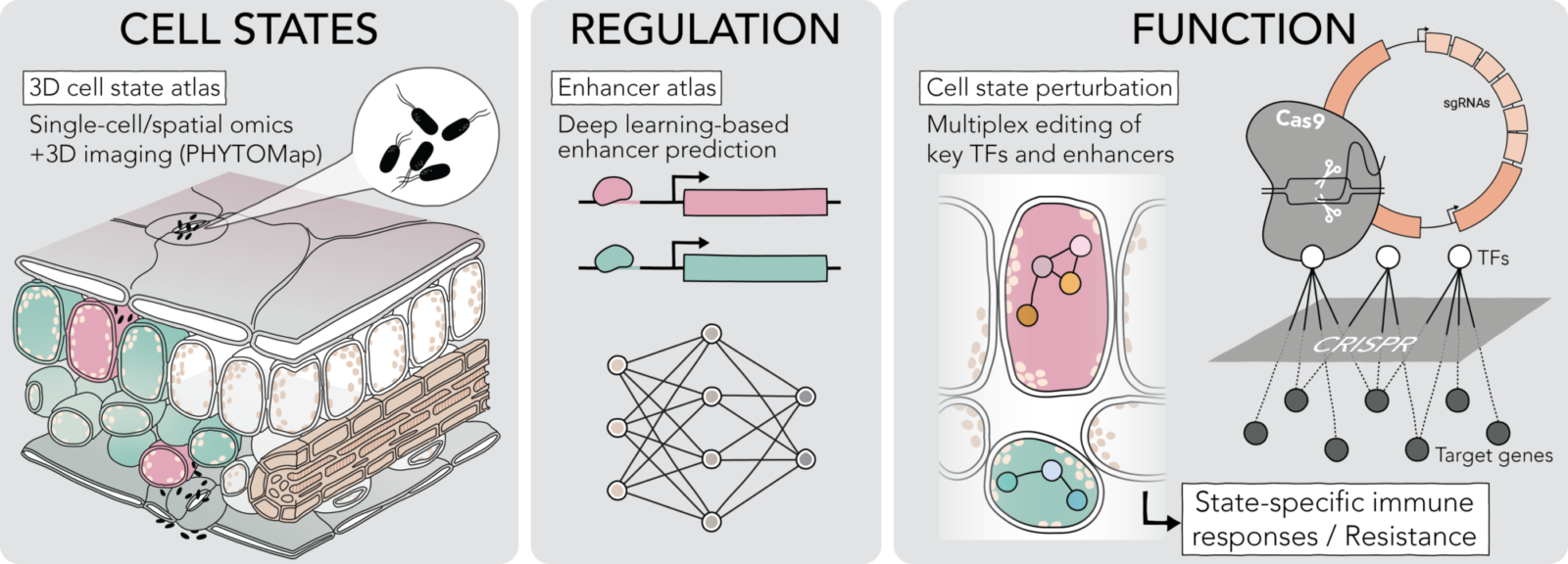
Image credits: Dr Hsuan Pai
Tatsuya's strategy will address three linked questions: what immune cell states exist, how are they regulated, and what do they do?
- Cell States: building on recent discovery of diverse plant immune cell states during bacterial infection, Tatsuya and his group will map the diversity of immune cell states and their positions. This will combine single-cell and spatial omics with PHYTOMap, a 3D gene-expression imaging method developed by Tatsuya, which the project will advance to visualise immune cell states alongside pathogen location in intact tissue.
- Regulation: scientists will identify DNA regulatory elements, including enhancers, that control immune cell states, and use deep learning to uncover the regulatory rules driving state-specific gene expression.
- Function: through multiplex genome editing, scientists will perturb key regulators and enhancers, testing how specific immune cell states contribute to disease resistance.
Together, these three approaches will allow Tatsuya and his group to map immune cell states, decode how they are controlled, and test their roles in plant immunity, shedding new light onto the mechanisms that protect plants against pathogens.
Redefining plant immunity for better, more resilient crops
ImmuneCellStates will bridge molecular and cellular perspectives on plant immunity, providing a pathway to understand the mechanisms underlying plant immunity at single-cell resolution. This interdisciplinary project will redefine the framework of plant immunity and lay the foundations for programmable immune cell states, with endless applications to crop engineering to improve plant resilience to pathogen attacks.
About the European Research Council (ERC)
The ERC, set up by the European Union in 2007, is the premier European funding organisation for excellent frontier research. It funds creative researchers of any nationality and age, to run projects based across Europe. The ERC offers four core grant schemes: Starting Grants, Consolidator Grants, Advanced Grants and Synergy Grants. With its additional Proof of Concept Grant scheme, the ERC helps grantees to bridge the gap between their pioneering research and early phases of its commercialisation. The ERC is led by an independent governing body, the Scientific Council. Since 1 November 2021, Maria Leptin is the President of the ERC. The overall ERC budget from 2021 to 2027 is more than €16 billion, as part of the Horizon Europe programme, under the responsibility of the European Commissioner for Innovation, Research, Culture, Education and Youth, Mariya Gabriel.