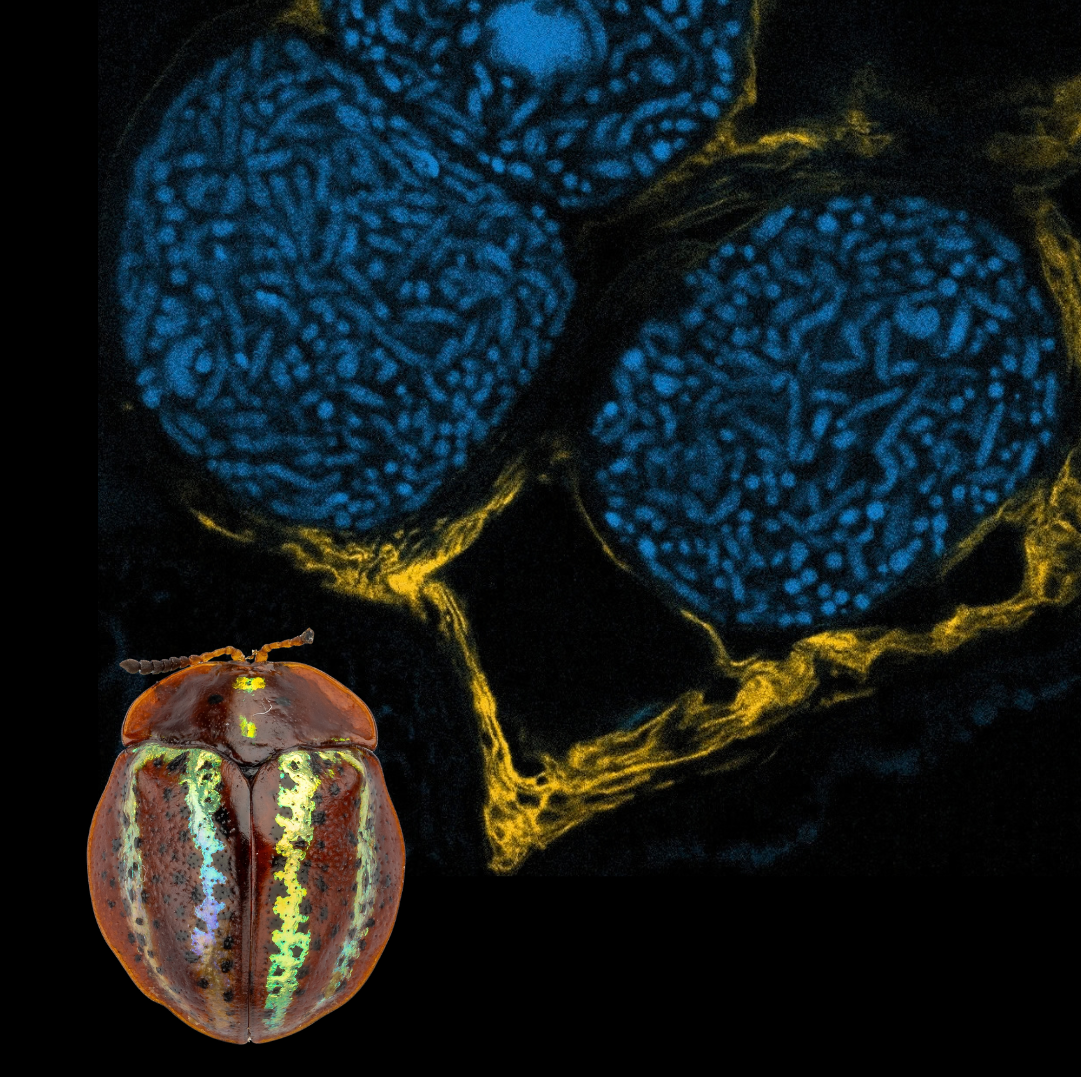
Immune cell states in the spotlight
As Tatsuya Nobori's group celebrates its one-year anniversary at The Sainsbury Laboratory, a new review presents his vision to place plant cell states at the heart of how we study and understand plant immunity.
By Laura Turchi and Mia Cerfonteyn
Building on the principle that individual plant cells are the first responders when pathogens attack, Tatsuya outlines a compelling approach to harness new technologies for uncovering the mechanisms of plant immunity at the single-cell level.
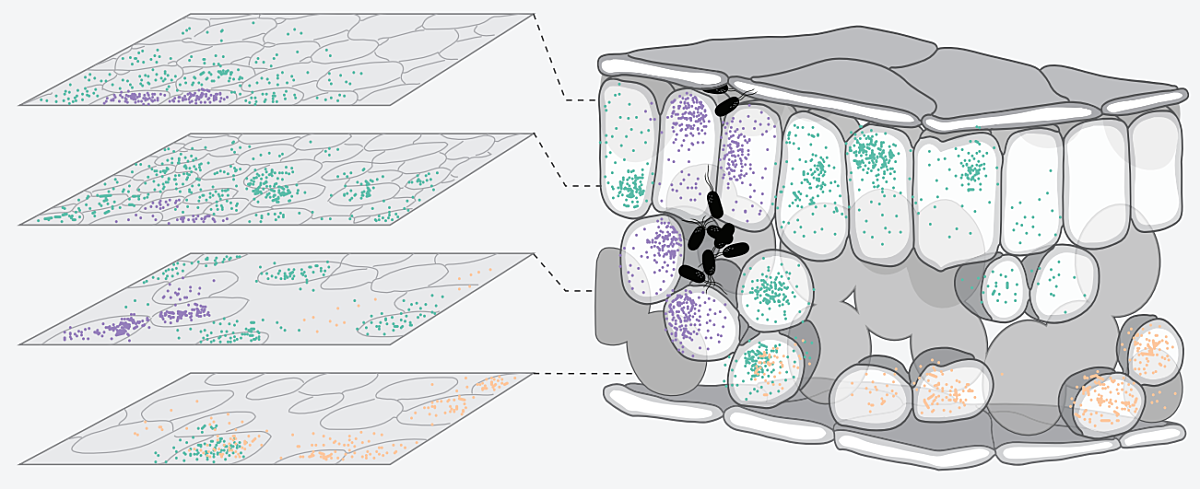
Image by Hsuan Pai.
"Immune cell states: critical building blocks of the plant immune system", Cell Host & Microbe
All plant cells stand ready to defend
Both plants and animals employ receptors to detect pathogens and trigger immunity. A key difference is that animals have dedicated immune cells that can travel through their system, whereas plants don't have these dedicated defences. Because plant cells are fixed in place, each cell needs to be able to respond to a pathogen attack and warn nearby cells to minimise damage.
This has made plant immunity especially interesting to study, as we still don't fully understand how cells can fulfill their function and coordinate an immune response during pathogen invasion.
Critical plant defence strategies are coming into focus
Modern advances in genomics and transcriptomics have allowed us to access massive datasets to investigate plant immune responses, providing key insights into gene regulation and signalling pathways. However, because these 'bulk omics' approaches rely on profiling entire tissues or organs, they mainly reflect the most prominent changes across many cells.
As a result, subtle or cell-specific changes can go unnoticed and vital spatial information, which can also influence the response of single cells, is missing.
However, thanks to exciting developments in single-cell and spatial omics technologies, scientists can now observe what happens inside individual cells within their spatial context at a level of resolution that was unimaginable just a few years ago.
Immune cell states as building blocks of the plant immune system
By integrating single-cell multiomics and spatial transcriptomics, Tatsuya recently discovered multiple immune states with distinct molecular and spatial characteristics upon pathogen attack.

When a plant cell detects a pathogen, it enters an immune state which can change over time and influence nearby cells.
In his review, Tatsuya calls for a shift in our gene-centric approach in studying plant immunity. Now that we know that similar cells can quickly take on different states in response to pathogens, we need to add a cell-centric perspective to better comprehend the complexity of the plant immune system.
Fully deciphering how immune states arise, interact, and coordinate responses is key to understanding how plants protect themselves from pathogens.
By layering different approaches, a clearer picture of how plant cells respond to pathogens starts to emerge:
- Integrate single-cell genomic technologies with spatial information to allow a more reliable identification of immune cell states.
- Incorporate epigenomic information to aid the construction of gene regulatory networks that give rise to different cell states.
- Combine cell state measurements with targeted manipulation to shed new light on the cellular basis of plant immunity, and how different immunity pathways are activated in plant cells.
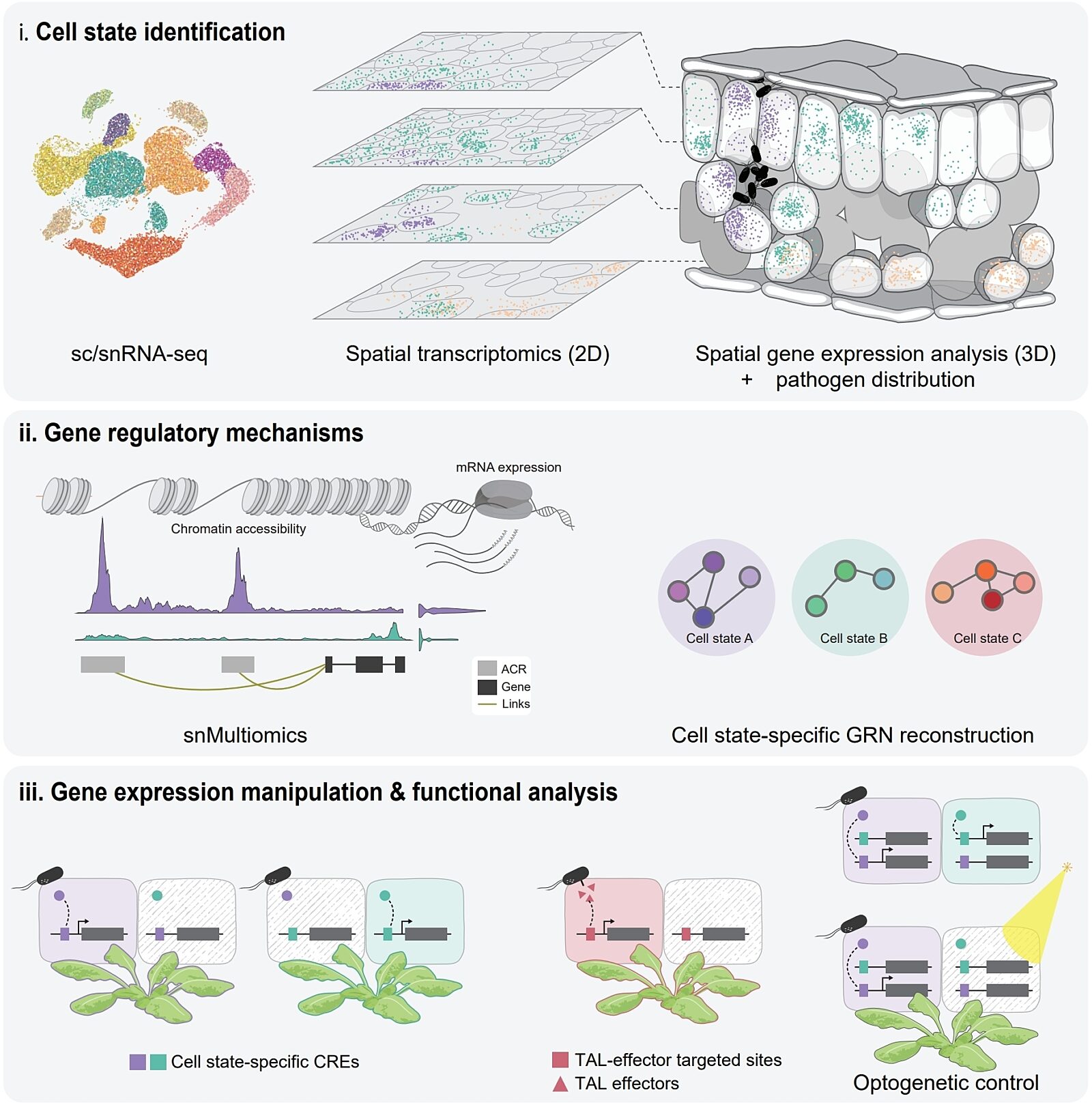
Toward understanding the diversity, regulation, and function of plant immune cell states "Immune cell states: critical building blocks of the plant immune system", Cell Host & Microbe. Image by Hsuan Pai.
Combining all these approaches will bridge the gap between tissue-level immunity and single-cell responses, enabling new leaps in our understanding of plant-pathogen interactions.
Tatsuya says, “I hope this article provides a useful conceptual framework for understanding the plant immune system at cellular resolution. With emerging technologies enabling new insights into immune cell states, this is an exciting time for the field, and we’re eager to contribute to its continued development.”