sRNA Revolution in Crop Defense: Wenbo Ma Wins ERC Advanced Grant
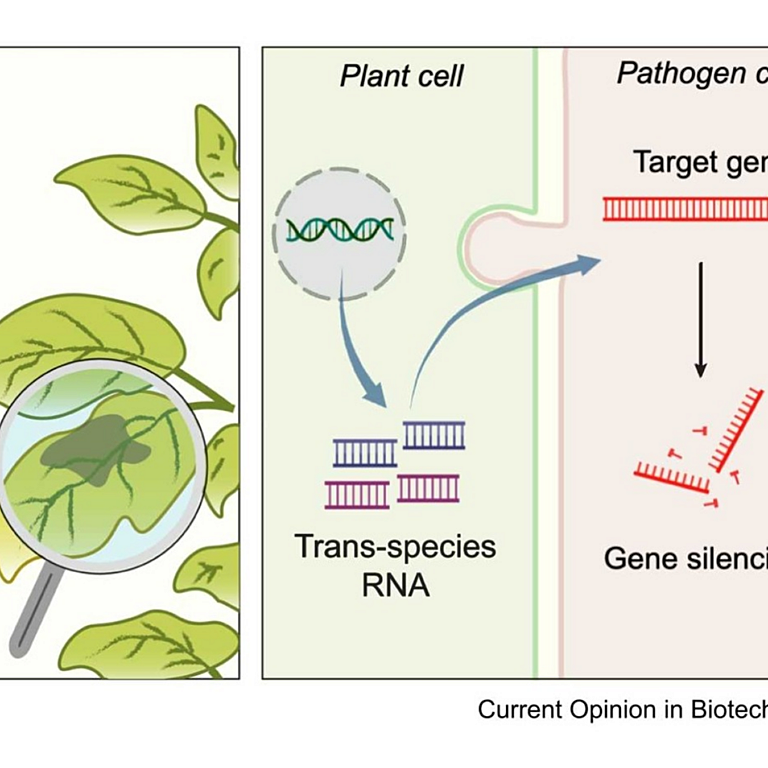
NORWICH, UK — Prof. Wenbo Ma of The Sainsbury Laboratory has been awarded a highly competitive European Research Council (ERC) Advanced Grant for her exciting new project, sRNA-Defense. The project aims to pioneer a new form of crop protection by harnessing the natural capacity of plants to produce antimicrobial small RNAs - a phenomenon known as natural host-induced gene silencing (nHIGS).
“We’re now at the point where we understand the natural system well enough to modify it precisely,” says Wenbo Ma, “That opens the door to entirely new strategies for crop protection.”

Small RNAs, Big Defenses
Crop diseases pose a severe threat to global food security, driving an urgent need for robust, broad-spectrum resistance. The high precision of small RNAs (sRNAs) - determined by sequence complementarity - makes them the agricultural equivalent of RNA-based human therapeutics.
While previous engineering attempts using artificial, transgene-derived sRNAs have yielded mixed results, the sRNA-Defense project charts a new path by building directly upon nature’s own mechanisms. By modifying natural RNA silencing-based immune pathways, the Wenbo Ma group aims to engineer crops with programmable, broad-spectrum resistance.
“Small RNAs act like molecular bullets,” Wenbo explains. “They directly target pathogen genes with precision. We can now enhance this system by designing small RNAs that are more effective in silencing selected pathogen gene(s), or a cocktail that targets multiple pathogens simultaneously.”
The Science Behind sRNA-Defense
During an infection, plants naturally produce a population of sRNAs that are engaged in silencing invading pathogen’s genes as a defense mechanism. Wenbo’s team recently achieved several breakthrough discoveries that lay the foundation for this project:
- Key Components Identified: The team located the specific pathogen-targeting sRNAs and the crucial ARGONAUTE (AGO) protein responsible for their production during infection.
- A Blueprint for Engineering: They uncovered an ancestral, yet diversified, gene cluster that acts as the precursor to these antimicrobial sRNAs, revealing a distinct biosynthetic pathway uniquely suited for bioengineering.
- Proof of Concept: In a major milestone, the lab successfully achieved sRNA production and disease resistance by expressing an nHIGS-sRNA-producing gene cassette in a heterologous system.
By employing innovative, multi-disciplinary approaches across genetics, genomics, biochemistry, and cell biology, sRNA-Defense will test the definitive hypothesis that nHIGS can be engineered for broad-spectrum crop protection.
"Harnessing the full potential of natural host-induced gene silencing requires a deep, mechanistic understanding of how plants inherently fight off pathogens. With the support of the ERC Advanced Grant, sRNA-Defense is ready to deliver fundamental new insights that will allow us to engineer precise, durable, and broad-spectrum disease resistance in staple crops." - Prof. Wenbo Ma
Reflecting on Our Small RNA Roots
The sRNA-Defense project is the latest milestone in an exciting lineage of RNA discovery that first took root right here in Norwich nearly thirty years ago.
The Sainsbury Laboratory has always been defined by bold ideas. Founded in 1987 on the principle of funding exceptional scientists rather than specific projects, the lab quickly garnered an international reputation for groundbreaking discoveries in molecular plant-microbe interactions.
Among TSL's earliest pioneers was Sir David Baulcombe, whose foundational discovery that plants generate short RNA molecules (now known as small RNAs) to defend against viruses revolutionized our understanding of gene regulation.
“What’s really remarkable is that David started out as a virologist studying plant–virus interactions,” says Wenbo, whose own research was deeply influenced by Baulcombe’s work before she joined TSL as a group leader in 2020. “It was precisely through exploring those plant-pathogen dynamics that he uncovered small RNAs."
The patent for David Baulcombe’s discovery - covering small RNA-based silencing (RNA interference, or RNAi) across all species, including mammals - was filed through TSL in 1999. This single breakthrough paved the way for transformative global applications, including revolutionary human therapeutics like Givosiran, a 2021 treatment for acute hepatic porphyria.
By 1999, Baulcombe’s team had also proposed that small RNAs could act as mobile silencing signals, a concept they experimentally confirmed in 2010 by proving these molecules travel between cells and throughout the plant’s vasculature.
A Cross-Kingdom Leap Across the Atlantic
Across the Atlantic, this conceptual shift sparked a bold new hypothesis for Wenbo Ma, then an Assistant Professor at the University of California, Riverside.
If viruses produce suppressors to block small RNA pathways, perhaps other eukaryotic pathogens do too.
However, this is conceptually different from the first discovery that plant small RNA targets viruses, because viral RNAs are inside the host cell, whereas other pathogens - like bacteria, fungi, oomycetes or insects - are extracellular.
“It was a risky project,” Wenbo recalls. “I told my postdoc: ‘If we don’t see anything in six months, we’ll drop it.’ Fortunately, he found a few promising candidates, and that gave us the momentum to pursue it.”

The hunch paid off and Wenbo’s team successfully demonstrated that plant small RNAs could target and silence genes inside an invading oomycete pathogen Phytophthora capsici, a phenomenon known as cross-kingdom gene regulation.
Revealing a sophisticated two-way molecular warfare
Wenbo’s lab identified the very first non-viral pathogen effectors that suppress host RNA silencing pathways. This finding provides compelling evidence that small RNA pathways are a primary battleground for plant defense.
In a landmark 2013 publication, her team revealed a sophisticated, two-way molecular warfare:
- The Defense: Host plants deliver small RNAs to silence pathogen genes and prevent infection.
- The Offense: Pathogens deliver effectors into host plants to suppress small RNA-based host immunity.
Today, this phenomenon has been shown in multiple systems, including Phytophthora and fungi. The precise mechanisms of RNA trafficking remain unclear, but the functional outcome is well supported: non-viral pathogens can also be silenced by plant-derived small RNAs.
“Pathogens evolve specific effectors to target the plant’s small RNA pathways,” says Wenbo. “Because they invest so much energy into blocking this system, it tells us the pathway is absolutely critical to plant defense. That insight has always been our guiding principle, and I think it’s shared by many in the molecular plant–microbe interaction field.”
In 2025, Wenbo Ma was elected a fellow to the Royal Society and she was handed her certificate by Vice President, Sir David Baulcombe, one of TSL’s first group leaders and a pioneer in small RNA discovery.

This article is based on an interview transcript with Prof. Wenbo Ma and her ERC proposal summary. Gemini was used as an AI editing assistant to improve narrative structure and concise language.
Related Research:
https://www.biorxiv.org/content/10.1101/2025.07.20.665670v1.full
Hamilton, A.J., and Baulcombe, D.C. (1999). A species of small antisense RNA in posttranscriptional gene silencing in plants. Science 286, 950– 952. https://doi.org/10.1126/science.286.5441.950.
Qiao Y., Shi J., Zhai Y., Hou Y., Ma W. Phytophthora effector targets a novel component of small RNA pathway in plants to promote infection. Proc. Natl. Acad. Sci. U.S.A. 2015;112(18):5850-5855. doi:10.1073/pnas.1421475112 UEA Research Portal+1
Hou Y., Zhai Y., Feng L., Karimi H.Z., Rutter B.D., Zeng L., Choi D.S., Zhang B., Gu W., Chen X., Ye W., Innes R.W., Zhai J., Ma W. A Phytophthora effector suppresses trans-kingdom RNAi to promote disease susceptibility. Cell Host & Microbe 2019;25(1):153-165.e5. doi:10.1016/j.chom.2018.11.007 UEA Research Portal+2PubMed+2
Ye W., Ma W. Filamentous pathogen effectors interfering with small RNA silencing in plant hosts. Curr. Opin. Microbiology 2016;32:1-6. doi:10.1016/j.mib.2016.04.003 UEA Research Portal+1
Gui X., Zhang P., Wang D., Ding Z., Wu X., Shi J., Shen Q.-H., Xu Y.-Z., Ma W., Qiao Y. Phytophthora effector PSR1 hijacks the host pre-mRNA splicing machinery to modulate small RNA biogenesis and plant immunity. The Plant Cell 2022;34(9):3443-3459. doi:10.1093/plcell/koac176 UEA Research Portal+2PMC+2